How Rimembo works
You speak. It writes. Everything after that is built on what you have already said.
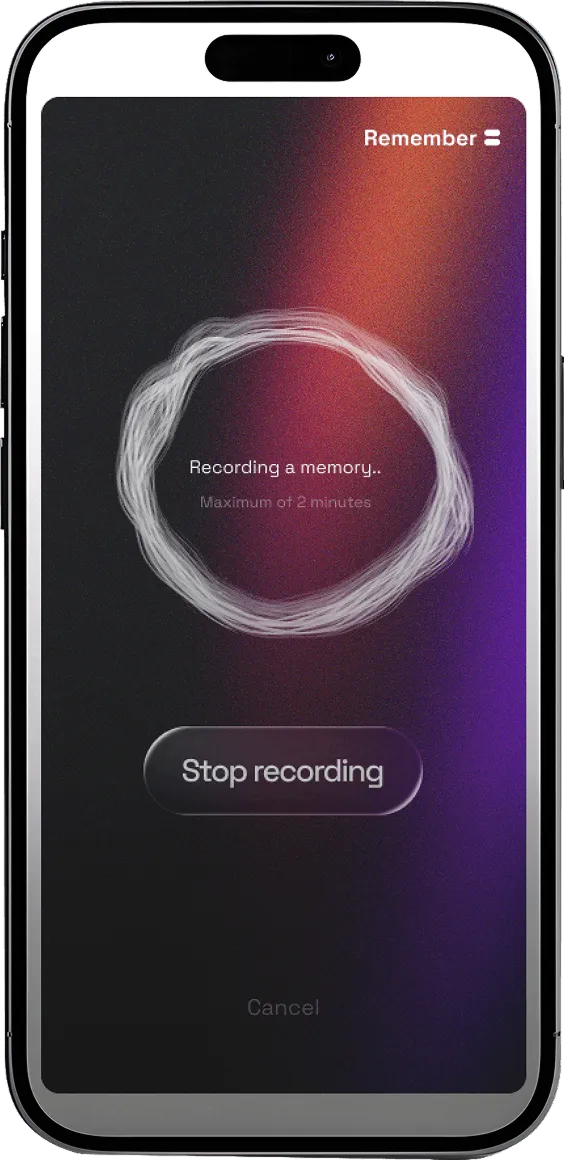
Step one
Say what happened
Out loud, in your own words. Ramble, pause, double back — none of that has to be tidy, and you never have to write anything down.
Step two
It comes back as a story
Rimembo turns the recording into something written you would actually want to read again — with a title, so you can find it later. It is a rewrite by a machine, not a transcript, so it can get things wrong. The story is yours to correct.
Step three
It stays somewhere you can find it
Every memory is searchable and sorted by what it is about, so a thing you said once in June is still reachable in December.
68%
Step four
It starts to be worth something
The more you keep, the more there is to draw on. Ask about something ahead of you and Rimembo answers from what you have already saved — then turn that into a challenge and hold yourself to it.
Saying it well
There is no wrong way to do this, but a few things make a memory better to read back. The app suggests the same four.
Pick one moment
Not your whole life — one afternoon, one room, one conversation.
Start with the senses
What did you see, hear, smell? Say that first, and the rest comes back.
Just talk — don’t perform
Ramble, pause, wander. Messy is good. We’ll clean it up.
End with why it stuck
One line: what it meant, how it felt, why you never forgot it.
On the phone you already carry
Rimembo is an app, on iPhone and on Android. There is no web version — your memories are not something we wanted sitting in a browser tab.
Keeping memories is free — 30 a month, up to 100 in total, with recordings up to 1 minute. Premium lifts those caps and adds the features built on top of your library.